Highlights from reading The Mezzanine
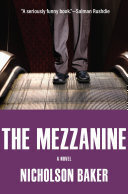
Finished reading: The Mezzanine by Nicholson Baker 📚
This is one of those books that is very much not for everyone but I enjoyed greatly.
The most basic version of the plot is: man rides up escalator
But it is written as a recounting of his thoughts during that time, full of tangents, digressions, and footnotes (what’s more fun that footnotes in fiction?)
And like many books I enjoy, the writing itself is a main character.
In response to plastic straws:
In this way the quality of life, through nobody’s fault, went down an eighth of a notch
The near simultaneity was very exciting—it made the variables of private life seem suddenly graspable and law-abiding.
On shoe tying:
it looked like a knot and functioned like a knot, but the whole thing was really an amazing interdependent pyramid scheme
With fewer total cells, but more connections between each cell, the quality of your knowledge undergoes a transformation: you begin to have a feel for situations, people fall into types, your past memories link together, and your life begins to seem, as it hadn’t when you were younger, an inevitable thing composed of a million small failures and successes, dependently intergrown, as opposed to a bright beadlike row of unaffiliated moments.
What is this static modernism that architects of the second tier have imposed upon us
Why should we need lots of nostalgia to license any pleasure taken in the discoveries that we carry over from childhood, when it is now so clearly an adult pleasure?
and suddenly all the squinting, cackling, cocktail-wickedness of a narrow gourmet jar of Spanish olives in the door shelf of your refrigerator inhabited the cheapest, most innocent, most childlike sandwich you can make.
But other things…have undergone disorienting changes, and the only way that we can understand the proportion and range and effect of those changes, which constitute the often undocumented daily texture of our lives (a rough, gravelly texture, like the shoulder of a road, which normally passes too fast for microscopy), is to sample early images of the objects in whatever form they take in kid-memories
You have to spot-check your likes and dislikes every so often in this way to see whether your reactions have altered, I think
was a significant change for people roughly my age—younger and you would have allied yourself completely with the novelty as your starting point and felt no loss; older and you would have already exhausted your faculties of regret on earlier minor transitions and shrugged at this change
Out of habit or a reverence for tradition, we continued
Predicting the app-based convenience economy?
they did not have home delivery and hence were not really members of society but loners and drifters.
the corporate bathroom is the one place in the whole office where you understand completely what is expected of you
People watch the news every night like robots, thinking they are learning about their lives, never paying attention to the far more immediate developments that arrive unreported
(blow up your tv, as John Prine says?)
Why do these images have to age before we can fond of them?
It is impossible to foresee the things that go wrong in these small innovations, and it takes time for them to be understood as evils and acted upon.
From this height, the height of sociology and statistics, foreshortened employees moved in visible patterns
That was the problem with reading: you always had to pick up again at the very thing that had made you stop reading the day before.
They knew that the outer surface of truth is not smooth, welling and gathering from paragraph to shapely paragraph, but is encrusted with a rough protective bark of citations, quotation marks, italics, and foreign languages, a whole variorum crust of “ibid.’s” and “compare’s” and “see’s” that are the shield for the pure flow of argument as it lives for a moment in one mind.